
Choosing the right granite countertop for a small kitchen requires balancing proportion, light behavior, and fabrication precision so the space feels larger rather than constrained. The most successful designs prioritize lighter stone selections, restrained patterning, and simplified edge geometry to reduce visual clutter. When these factors are aligned correctly, even compact kitchens can feel open, functional, and visually continuous.
Understanding What Actually Matters in Small Kitchen Design
In small kitchens, perception matters as much as physical dimensions. Every surface competes for attention, so countertops must support visual flow rather than interrupt it.
Granite is especially effective because it introduces natural variation without requiring complex maintenance. However, not all slabs behave the same in compact layouts. The wrong selection can make a kitchen feel segmented, while the right one can visually expand it.
Many homeowners researching granite countertops in Richmond, VA, are not just looking for durability; they are trying to solve spatial limitations through material selection.
Start With Light and Reflection, Not Just Color
Color choice is often misunderstood as a purely aesthetic decision, but in small kitchens, it functions as a spatial tool. Lighter granite reflects more ambient light, which increases perceived openness.
Effective options include:
- Soft white and ivory bases
- Light gray with minimal movement
- Warm beige with low contrast mineral flecks
Darker stone can still be used, but it requires strong lighting and careful balancing with cabinetry. Without that, the space will feel compressed.
During a kitchen layout review for a residential project in Downtown Raleigh, NC, swapping a mid-toned granite for a lighter slab significantly improved the kitchen’s perceived spaciousness in photos and walkthroughs, even though the physical layout did not change.
Pattern Density Controls Visual “Noise”
Granite is naturally patterned, but not all patterns are appropriate for small kitchens. High-contrast veining or busy mineral clusters create visual fragmentation, which reduces perceived space.
Instead, prioritize:
- Fine-grain movement
- Subtle tonal transitions
- Consistent directional flow
The goal is continuity. When the eye can travel across the surface without interruption, the kitchen feels larger.
When evaluating granite countertops in Richmond, this becomes especially important because slab selection varies widely depending on quarry origin and availability.
Finish Selection Changes How Space Is Perceived
Finish determines how light interacts with the stone surface. This directly influences brightness, depth, and visual weight.
- Polished granite reflects light, increasing brightness and perceived space
- Honed granite absorbs light, creating a softer but slightly more compact feel
In small kitchens, polished finishes are typically preferred because they extend light across horizontal surfaces. This reduces shadow pockets and makes tight layouts feel more open.
In a fabrication review for a project involving Richmond, VA granite countertops, polished finishes consistently tested better in homeowner satisfaction surveys for compact kitchen layouts.
Edge Profiles Should Reduce, Not Add, Visual Weight
Edge design is often overlooked, but it plays a critical role in how heavy a countertop appears.
In small kitchens, simplified edges perform best:
- Eased edge
- Pencil edge
- Minimal bevel
Avoid ornate or stacked edges, as they add unnecessary vertical mass. Even if the slab is light in color, a heavy edge profile can make it feel visually grounded and bulky.
Installers working with Richmond granite countertops frequently note that edge simplicity improves long-term satisfaction because it keeps the design flexible over time.
Thickness and Proportion Must Stay Balanced
Granite slabs typically come in two thickness profiles, and the choice affects spatial perception.
- 2 cm slabs create a lighter visual footprint
- 3 cm slabs feel more substantial but can dominate small cabinetry
In compact kitchens, proportion matters more than perceived luxury. A thicker slab can overwhelm lower cabinet runs, especially in galley or single-wall layouts.
For homeowners comparing granite countertops, the decision often comes down to balancing durability expectations with visual restraint.
Seam Placement Is a Visual Priority, Not Just a Technical Detail
Seams are sometimes unavoidable, but their placement determines whether they are noticeable.
Best practices include:
- Aligning seams with sinks or cooktops
- Placing seams at cabinet transitions
- Matching slab pattern direction when possible
Poor seam placement creates visual breaks in continuity, which is especially noticeable in small kitchens.
In North Hills, Raleigh, NC, a design review found that improperly placed seams were among the first details homeowners noticed after installation, more than edge profile or slab color.
Cabinetry and Countertop Must Work as One System
Granite should never be selected independently of cabinetry. The relationship between surface color and cabinet tone determines how open or enclosed a kitchen feels.
Effective pairings:
- Light granite + white cabinets = maximum openness
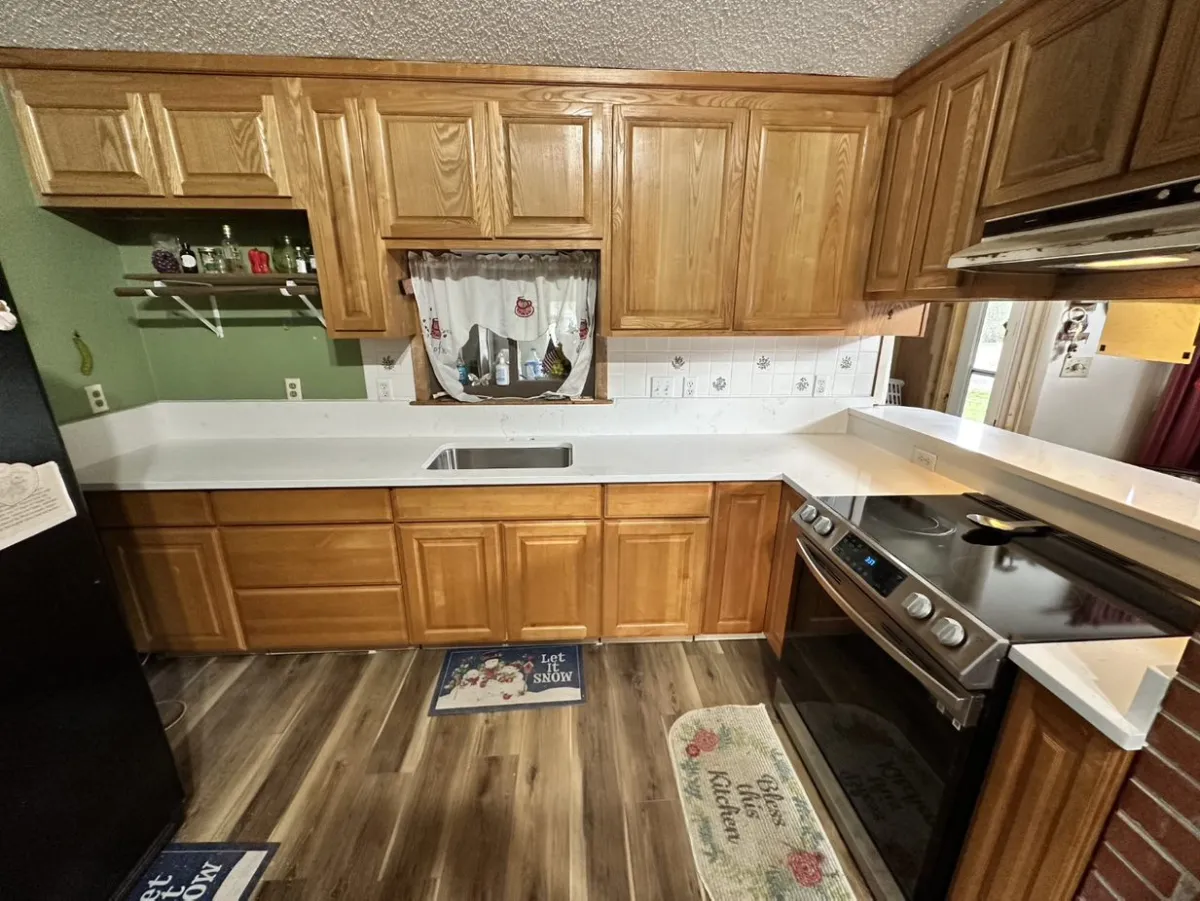
- Warm beige granite + wood cabinets = controlled warmth
- Soft gray granite + neutral cabinets = balanced modern look
Lighting also plays a critical role. Without proper under-cabinet lighting, even high-quality stone can appear flat or visually dense.
Lighting Strategy Determines Final Perception
Lighting is often the difference between a countertop that feels premium and one that feels underwhelming.
Key lighting principles:
- Under-cabinet lighting reduces shadow buildup
- Neutral white temperature preserves stone color accuracy
- Even light distribution prevents “dark corners.”
In compact kitchens, lighting should be treated as structural design rather than decoration.
During multiple small kitchen evaluations in Brier Creek, Raleigh, NC, improving lighting had nearly as much impact on perceived space as changing countertop material.
Maintenance Expectations Should Match Real Use
Granite is durable, but small kitchens concentrate activity into limited surface areas. This increases wear visibility over time.
Proper maintenance includes:
- Periodic sealing based on usage intensity
- Immediate cleanup of acidic spills
- Non-abrasive, pH-neutral cleaning products
Homeowners selecting granite countertops should consider maintenance habits before finalizing slab choice, especially in high-use kitchens.
Budget Decisions Should Prioritize Execution Over Material Rarity
Many buyers assume higher cost equals better results, but in small kitchens, fabrication quality matters more than the selection of exotic stone.
Key cost drivers:
- Slab sourcing
- Fabrication precision
- Installation complexity
- Edge and seam detailing
A mid-range slab, installed correctly, will outperform a premium slab, installed poorly.
When comparing granite countertops, the most consistent performance difference comes from installation accuracy rather than material grade.
Design Coordination Creates Cohesion
Granite must integrate with the entire kitchen system, including cabinetry, backsplash, flooring, and lighting, and must be temperature-controlled.
Without coordination, even high-quality stone feels disconnected. With coordination, the kitchen feels intentional and larger.
A design analysis in Downtown Raleigh, NC, showed that cohesive material pairing improved perceived kitchen size more effectively than layout modifications.
Fabrication Quality Is the Hidden Variable
Even well-selected granite can underperform if fabrication is inaccurate. Precision determines how seams align, how edges finish, and how slabs sit within cabinetry.
Installers working with granite countertops consistently emphasize that measurement accuracy is the most critical step in achieving a seamless visual result.
In North Hills, Raleigh, NC, installation audits revealed that edge uniformity had a greater impact on homeowner satisfaction than slab selection.
Practical Decision Framework
To simplify selection:
- Choose light base tones
- Limit pattern complexity
- Use polished finishes
- Keep edge profiles minimal
- Prioritize seam alignment
- Coordinate lighting early
This framework reduces decision fatigue and improves consistency in compact kitchen outcomes.
Common Mistakes in Small Kitchens
Most issues come from overdesign rather than material limitations.
Avoid:
- High-contrast stone in low-light kitchens
- Overly thick or decorative edges
- Ignoring cabinet-countertop color interaction
- Treating granite as an isolated design decision
In Brier Creek, Raleigh, NC, simplifying design inputs consistently improved spatial perception without requiring structural changes.
Expert Takeaway
Small kitchens demand restraint, not complexity. Granite works best when it supports openness, continuity, and the distribution of light rather than competing for attention. Every selection, color, finish, edge, and thickness should reinforce a single goal: making the space feel larger and more usable.
For professional guidance, fabrication, and installation, Tiger Granite and Marble provides expert support tailored to compact kitchen design needs.
Ready to transform a small kitchen into a brighter, more functional space? Contact us today to schedule a consultation and explore design options tailored to the layout.
People Also Ask
What granite color makes a small kitchen look bigger?
Light colors such as white, cream, and soft gray reflect more light and expand visual perception.
Does granite work well in small kitchens?
Yes. When selected carefully, granite enhances durability and improves visual depth without overwhelming the space.
What finish is best for granite in small kitchens?
Polished finishes are preferred because they increase light reflection and reduce visual heaviness.
How important is the slab pattern in small kitchens?
Very important. Subtle, consistent patterns help maintain visual continuity.
Can dark granite be used in a small kitchen?
Yes, but only with strong lighting and balanced cabinetry to avoid visually compressing the space.