
Granite countertops remain one of the most durable and visually appealing choices in kitchen remodels, but they are not maintenance-free. Homeowners prevent staining and etching by following proper sealing schedules, cleaning with pH-neutral products, and quickly addressing spills before they penetrate or react with the surface. When these habits are established during the remodel phase rather than after installation, the stone maintains its polished finish and structural integrity for years.
The key to long-term performance is understanding that granite is both porous and chemically reactive to acids, even though it appears solid and impervious.
Why granite requires maintenance even in modern kitchens
Granite is an igneous natural stone composed primarily of quartz, feldspar, and mica. While dense and heat-resistant, it contains microscopic pores that can absorb liquids over time if the protective seal wears down.
Two distinct types of damage occur in everyday kitchens:
Staining (absorption into the stone)
Staining happens when liquids penetrate the surface and become trapped within the stone’s microstructure. This is often gradual and not immediately visible until discoloration sets in.
Common sources include:
- Cooking oils and grease
- Coffee, wine, and tea
- Sauces and food dyes
- Hard water deposits near sinks
Once absorbed, stains can be difficult to remove without professional restoration techniques such as honing or deep extraction.
Etching (surface chemical reaction)
Etching is different from staining. It is a chemical reaction that alters the polished surface rather than penetrating it. Acidic substances break down mineral bonds, leaving dull or cloudy marks.
Common triggers include:
- Citrus juices
- Vinegar-based cleaners
- Tomato-based foods
- Carbonated beverages
Etching cannot be cleaned away; it requires polishing or resurfacing.
How kitchen habits affect granite longevity
Not all granite countertops age at the same rate. Daily kitchen habits often have a greater impact on long-term performance than the stone itself.
Factors that accelerate wear include:
- Frequent cooking with oils and grease
- Leaving spills unattended for extended periods
- Using harsh chemical cleaners
- Preparing acidic foods directly on the countertop
- Excessive moisture exposure around sink areas
Conversely, homeowners who use cutting boards, wipe spills promptly, and follow a consistent cleaning routine typically experience fewer maintenance issues and longer-lasting finishes.
Understanding how everyday use affects granite helps homeowners establish realistic maintenance expectations and avoid preventable damage.
Sealed vs unsealed granite performance comparison
Sealing is the most important protective step in Richmond granite countertops. However, it does not make stone impervious; it only slows absorption.
| Property | Properly Sealed Granite | Unsealed Granite |
| Resistance to stains | High resistance to absorption | Rapid liquid penetration |
| Resistance to etching | Moderate protection | No protection |
| Maintenance effort | Predictable routine care | Frequent restoration needed |
| Appearance over time | Maintains polish longer | Dulls quickly |
Sealants gradually break down through cleaning, heat exposure, and daily use, which is why ongoing maintenance is essential.
Practical maintenance routine homeowners should follow
1. Daily cleaning habits (most important step)
Daily care prevents long-term buildup and surface degradation.
Recommended approach:
- Wipe surfaces with a microfiber cloth
- Use a pH-neutral stone cleaner or mild dish soap
- Clean spills immediately, especially oils and acidic liquids
- Dry the surface after cleaning to avoid water spotting
Consistency matters more than product complexity.
2. Weekly deep cleaning (high-use kitchen zones)
Weekly cleaning focuses on areas that accumulate residue faster:
- Around the sink and faucet base
- Cooking and prep areas
- Counter edges and appliance zones
This prevents gradual buildup that can weaken sealant performance over time.
3. Monthly inspection (early detection system)
A simple monthly check helps identify early wear before damage occurs.
Look for:
- Water no longer beading on the surface
- Uneven sheen or dull patches
- Increased absorption in high-use areas
A water drop test is commonly used: if water absorbs within minutes, resealing is needed.
4. Sealing schedule (core protective layer)
Sealing is the most critical long-term maintenance step.
Most granite countertops in Richmond require sealing every 12–18 months depending on usage. High-traffic kitchens may require more frequent application.
Basic sealing process:
- Clean and dry the surface completely
- Apply a penetrating stone sealer evenly
- Allow curing for 12–24 hours
- Buff surface for uniform finish
Proper sealing significantly reduces the risk of deep staining.
What homeowners should use and avoid when cleaning granite
Safe cleaning options
- pH-neutral stone cleaners
- Mild dish soap with warm water
- Soft microfiber cloths
Products that cause damage
- Vinegar or lemon-based cleaners (cause etching)
- Ammonia or bleach (break down sealants)
- Abrasive pads or powders (scratch polished finish)
Many countertop issues are caused not by the stone itself, but by improper cleaning products used over time.
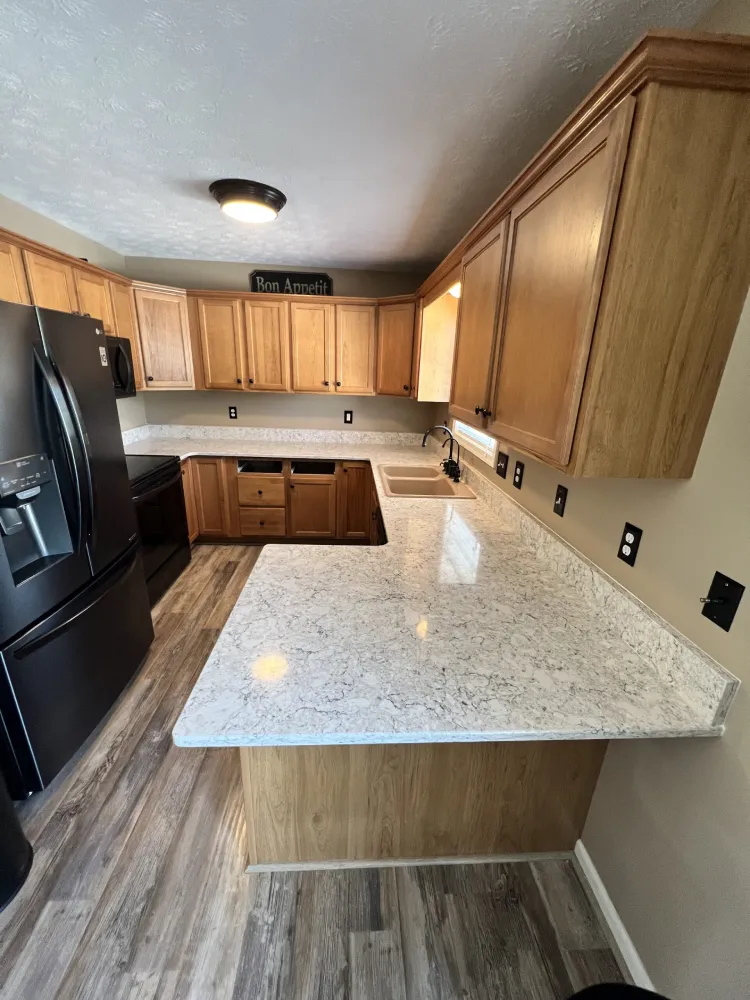
Seasonal maintenance checklist for granite countertops
A seasonal inspection helps homeowners stay ahead of potential issues before they become expensive repairs.
Every 3–4 months, homeowners should:
- Perform a water-bead test to evaluate sealant performance
- Inspect sink areas for hard water buildup
- Check countertop seams for signs of separation
- Examine high-use prep zones for dull spots
- Remove residue around cooktops and backsplashes
Annually, homeowners should:
- Evaluate whether resealing is necessary
- Schedule professional polishing if gloss levels have diminished
- Inspect countertop edges for chips or impact damage
Following a seasonal maintenance schedule creates a proactive approach to countertop care and helps preserve both appearance and functionality.
Granite sealing explained in simple terms
Understanding sealing helps homeowners make better maintenance decisions during a remodel.
Porosity
Porosity refers to how easily liquids can pass into the stone. Even dense granite has microscopic pores that allow absorption if unprotected.
Penetrating sealers
These soak into the stone, forming internal protection. They are widely used in kitchen installations because they do not alter appearance.
Cure time
This is the period required for sealers to fully bond with the stone surface, typically 12–24 hours.
Water-bead test
A practical way to check seal effectiveness:
- Water beads = seal is intact
- Water spreads or absorbs = resealing needed
A structured approach to long-term granite care
Homeowners planning a remodel benefit from treating maintenance as a system rather than a reaction to problems, especially when working with materials like granite countertops in Richmond, VA.
1. Usage-based planning
Maintenance frequency should reflect how the kitchen is used:
- Heavy cooking households require more frequent sealing
- Light-use kitchens can extend intervals
2. Risk zone identification
Certain areas experience more wear:
- Sink and faucet zones
- Cooking and prep surfaces
- Areas near acidic food preparation
3. Preventive scheduling
Instead of waiting for damage to occur, schedule maintenance based on usage patterns and visible wear indicators.
This approach reduces long-term repair costs and preserves finish quality.
Common misconceptions about granite maintenance
Granite is often misunderstood because of its reputation for durability.
| Misconception | Reality |
| Granite is non-porous | It naturally contains microscopic pores |
| Sealing makes it waterproof | It only slows absorption |
| Any cleaner is safe | Acidic cleaners damage the surface |
| Etching is dirt | It is permanent surface alteration |
These misconceptions often lead to premature countertop dulling and avoidable restoration work.
When professional granite restoration may be necessary
While routine maintenance prevents most countertop issues, some forms of damage require professional restoration.
Signs that professional attention may be needed include:
- Deep oil or grease stains that do not respond to cleaning
- Large etched areas causing visible dullness
- Surface scratches affecting the polished finish
- Persistent hard water deposits around sinks
- Uneven coloration caused by sealant failure
Professional restoration techniques may include honing, polishing, stain extraction, and resealing. Addressing these issues early often prevents more extensive repairs and helps restore the countertop’s original appearance.
For homeowners investing in a kitchen remodel, understanding when to seek professional assistance is just as important as maintaining a regular cleaning and sealing routine.
About Tiger Granite and Marble
Tiger Granite and Marble specializes in the fabrication, installation, and restoration of natural stone surfaces including granite, marble, and quartz. Their process includes slab selection, precision cutting, edge profiling, and professional installation designed to optimize durability and aesthetic performance.
They also provide guidance on proper sealing schedules and maintenance practices tailored to specific stone types and kitchen usage patterns, helping homeowners extend the lifespan of their countertops.
In Summary
Granite countertops remain a high-performance kitchen surface when maintained correctly, and at Tiger Granite and Marble, this long-term success depends on three consistent actions: proper sealing, safe cleaning practices, and immediate spill response. With a structured care routine established during the remodel phase, granite retains its natural beauty and durability for many years.
For expert fabrication, installation, and maintenance support tailored to your kitchen remodel, contact us today.
Frequently asked questions
How often should granite countertops be sealed?
Most granite surfaces require sealing every 12–18 months, depending on usage intensity and stone porosity.
What is the safest cleaner for granite?
A pH-neutral stone cleaner or mild dish soap solution is recommended for daily use.
Can acidic foods damage granite permanently?
Yes. Acidic substances can etch the polished surface, leaving permanent dull marks.
How can I tell if my granite needs resealing?
If water no longer beads and instead absorbs into the surface, resealing is required.