
The best countertop edge profile is the one that fits how the kitchen is used, not just how it looks. A straight edge is clean and simple, a beveled edge adds a crisp angled detail, and an ogee edge brings a curved, traditional shape. Each one also cleans, wears, and feels a little differently every day.
Tiger Granite and Marble offers straight, beveled, and ogee edges on its stone countertops. This guide covers what each edge looks like, how it holds up, and the practical details homeowners often notice only after installation.
What Is a Countertop Edge Profile?
The edge profile is the shape cut into the exposed front and side edges of a countertop. It is the part people touch, lean on, and bump into most. The profile is shaped during fabrication, after the slab is cut to size.
Edge profiles affect three things:
- Look. The edge sets the tone of the whole countertop, from modern to traditional.
- Feel and safety. Some edges feel sharper, while others are softer to the touch.
- Upkeep. Detailed curves hold more crumbs and spills than flat faces.
What Are the Three Main Edge Options?
Straight Edge
A straight edge has a flat, vertical face with square top and bottom corners. It is the simplest profile and one of the most common. It shows off the stone itself instead of the edge detail, which suits modern and transitional kitchens.
Fabricators usually soften the corners slightly so they are not razor-sharp. This small detail helps the edge feel better to the touch and makes it less likely to chip.
Beveled Edge
A beveled edge has an angled cut along the top corner, usually at about 45 degrees. The angle catches light and gives the countertop a crisp, finished line. A beveled edge fits many styles, from simple and modern to classic.
Because the bevel removes the sharpest part of the corner, it tends to resist chipping better than a square corner and feels less sharp against hips and hands.
Ogee Edge
An ogee edge has an S-shaped curve, often a concave curve flowing into a convex one. It is the most decorative of the three. An ogee-edge countertop in Richmond, VA is a popular choice for traditional kitchens, formal spaces, and homes with detailed cabinetry or crown molding.
The curves add depth and shadow along the front of the counter. They also take a little more care to keep clean, which is covered below.
How Do the Edges Compare?
| Edge | Look | Cleaning | Chip resistance | Best fit |
|---|---|---|---|---|
| Straight | Clean, simple, modern | Easiest: flat face wipes clean | Good when corners are slightly softened; sharp square corners chip more easily | Modern, transitional, busy family kitchens |
| Beveled | Crisp angled line that catches light | Easy: flat faces with one angle | Good: the angle removes the sharpest point | Most styles, from modern to classic |
| Ogee | Curved, decorative, traditional | More effort: curves can trap crumbs and spills | Good on the rounded curves; detail can show wear if hit hard | Traditional kitchens, formal spaces, bars |
What Practical Details Do Homeowners Often Miss?
How Easy Is Each Edge to Clean?
Flat faces wipe clean in one pass. Straight and beveled edges are the easiest to keep tidy because there is nowhere for crumbs to settle.
The curves in an ogee edge can collect crumbs, flour, and dried drips, especially at the inside curve near the bottom. A soft cloth or sponge run along the profile takes care of it, but it is an extra step to keep in mind for a kitchen that sees a lot of baking or messy cooking.
Which Edges Chip Less?
Chips usually start at sharp corners, where force from a dropped pan or a bumped pot is concentrated on a small point. A perfectly square corner is the most likely to chip.
Slightly softened corners help a lot. A beveled edge removes the sharp point by design. Ogee edges are rounded on the front, which spreads out impact, though a hard hit on the detailed lip can still leave a mark.
What About Small Children?
For homes with toddlers, edge height often lines up with a child’s head. Sharp square corners are the least forgiving. Edges with softened or rounded corners are a gentler choice in these homes, and soft corner guards can be added during the early years if needed.
How Does the Edge Change the Look of Thickness?
The edge profile affects how thick the countertops in Richmond appear. A straight edge shows the full thickness of the slab as a flat band, which can look bold and solid. A beveled edge makes the top line look a little slimmer. An ogee edge breaks up the face with curves, so the slab can look more detailed and less blocky.
Homeowners who want a heavy, substantial look often prefer a straight edge. Those who want a lighter look may lean toward a bevel.
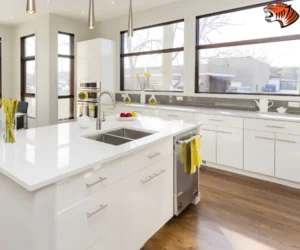
How Should the Edge Match the Kitchen Style?
- Modern or minimal kitchens usually pair best with straight edges and flat-panel cabinets.
- Transitional kitchens often suit straight or beveled edges.
- Traditional kitchens with raised-panel cabinets, crown molding, or detailed trim often suit an ogee edge.
The stone itself matters too. A busy granite with lots of movement can look calmer with a simple edge, while a quieter stone can carry a more decorative profile.
Can the Island and Perimeter Have Different Edges?
Yes, and many homeowners do this. A common approach is a simple straight or beveled edge on the perimeter counters, which get the most daily wear and cleaning, with an ogee edge on the island as a focal point. The reverse can also work in a modern kitchen with a statement island.
When mixing edges, keeping the same stone or a close color match helps the two areas feel connected.
What Happens Where the Edge Meets the Sink or Dishwasher?
The edge profile mainly shows on the front and exposed sides of the Richmond countertop, but it also matters near the sink and dishwasher.
- At the sink, water runs over the front edge often. Flat and beveled edges let water wipe off easily, while ogee curves may hold drips that need a quick wipe.
- At the dishwasher, steam rises against the underside and front edge when the door opens after a cycle. Letting the steam clear before opening fully is a good habit for any countertop.
- At undermount sinks, the cutout itself gets its own finished edge, separate from the front profile. When reviewing the plan, homeowners can ask how the sink cutout will be finished.
Are There Other Edge Profiles?
Other edges exist in the industry, such as eased edges and bullnose edges. Homeowners interested in a profile beyond straight, beveled, and ogee should ask the Tiger Granite and Marble team which additional profiles are available for their project.
Does the Edge Affect Cost?
The edge profile is one of several factors that shape a countertop quote. Others include the stone selected, the total square footage, the number of cutouts for sinks and cooktops, and the length of exposed edge. More detailed profiles take more fabrication work. A quote based on accurate measurements gives the clearest picture.
Frequently Asked Questions
What is the most popular countertop edge profile?
Straight edges with slightly softened corners are among the most common choices because they are simple, easy to clean, and fit many styles. Beveled and ogee edges are popular when homeowners want more detail. The right choice depends on the kitchen’s style and how it is used.
Is an ogee edge hard to clean?
An ogee edge is not hard to clean, but it takes a little more attention than a flat edge. The curves can collect crumbs and drips, especially near the bottom of the profile. Running a soft cloth along the edge during regular cleanup keeps it looking good.
Does a beveled edge countertop chip less than a straight edge?
A beveled edge removes the sharp top corner, which is where most chips start. That generally makes it more chip-resistant than a sharp square corner. A straight edge with slightly softened corners also holds up well.
Can different edges be used in the same kitchen?
Yes. Many kitchens use a simple edge on the perimeter and a more decorative edge on the island. Keeping the stone consistent helps the two areas look like they belong together.
Which edge is safest for homes with young children?
Edges with softened or rounded corners are gentler than sharp square corners if a child bumps into them. Beveled edges and straight edges with eased corners are both reasonable options. Corner guards can add extra protection during the toddler years.
Choose the Right Edge with Tiger Granite and Marble
Tiger Granite and Marble fabricates granite, marble, quartz, and quartzite countertops with straight, beveled, and ogee edges for homes in Richmond and surrounding areas. The family-owned team takes careful measurements of the space so each countertop is cut to the right size and shape, and they can talk through which edge suits the kitchen’s style and daily routine.
Ready to see how these edge profiles look in person or talk through the options for your space? Contact us today to schedule a consultation, explore stone samples, or get an accurate quote for your kitchen project.