
The ideal countertop thickness for a heavy-duty laundry folding station depends on the material, span, support, edge design, and intended use. Granite, marble, and quartz offer durable surfaces, but proper support and installation are just as important as thickness.
Why Does Countertop Thickness Matter In A Laundry Room?
A laundry station can hold baskets, detergents, hampers, and folded clothes, while the work surface needs to withstand regular use during sorting and folding.
Thickness affects the amount of material in the countertop and can influence its appearance, edge profile, and structural characteristics. However, a thicker slab cannot compensate for inadequate cabinet support or an improperly designed overhang.
For homeowners researching laundry countertops in Richmond, VA, the best approach is to consider how the countertop will be used and supported rather than simply selecting the thickest available option.
What Countertop Thickness Options Are Common?
Natural stone and engineered stone countertops are commonly available in different thicknesses. Approximately 2 cm and 3 cm slabs are common industry options, although availability depends on the material, supplier, fabricator, and project.
| Thickness Option | General Consideration |
| 2 cm | Lighter profile and may require additional fabrication or support |
| 3 cm | More substantial appearance and commonly used for countertops |
| Built-up edge | Creates the appearance of greater thickness along the edge |
| Custom fabrication | Allows thickness and edge treatment to match the project |
These are general considerations rather than universal structural requirements. The appropriate specification should be confirmed by the fabricator based on the actual material, dimensions, support, and installation.
What Factors Matter More Than Thickness?
Countertop performance depends on more than slab thickness. Key factors include:
- Countertop Span: Longer unsupported areas may require additional support.
- Support Structure: Cabinets, walls, and brackets help carry the countertop’s weight and loads.
- Material: Granite, marble, and quartz have different durability and maintenance characteristics.
- Overhang: Larger overhangs may need additional support based on the material and design.
- Cutouts and Seams: Sink, appliance, and fixture cutouts should be considered during fabrication and installation.
How Should You Choose Thickness For A Heavy Folding Station?
A practical selection process begins with the actual laundry-room layout.
Step 1: Determine The Dimensions
Measure the planned countertop length and depth. A short surface supported by several cabinets has different requirements from a long floating folding station.
Step 2: Choose The Material
Consider granite, marble, or quartz based on appearance, maintenance expectations, durability, and budget.
Step 3: Map The Support Points
Identify where cabinets, walls, brackets, or other structural elements will support the countertop.
This becomes particularly important for longer folding stations.
Step 4: Consider The Edge Profile
A countertop does not necessarily need a thicker slab to create a substantial-looking edge. A built-up edge can create the appearance of greater thickness while using a different slab configuration.
Step 5: Consider Expected Use
Typical laundry-room loads may include:
- Laundry baskets
- Hampers
- Folded clothing
- Detergent containers
- Cleaning supplies
- Small household items
The countertop should be designed for realistic use rather than an assumed extreme load.
Step 6: Confirm The Fabricator’s Recommendation
The final thickness should be confirmed after the fabricator reviews the material, dimensions, support structure, overhangs, seams, and installation conditions.
Does A Thicker Countertop Always Mean A Stronger Laundry Station?
No.
Thickness is only one part of countertop performance. A thicker slab installed over inadequate support may not perform as well as a properly supported countertop with an appropriate thickness.
The countertop, cabinets, brackets, walls, and installation method function as a system.
For example, a homeowner in The Fan planning a long folding station should consider the entire cabinet and support layout before deciding whether additional thickness is necessary.
Which Countertop Materials Work Well in Laundry Areas?
Laundry countertops should balance durability, appearance, maintenance, and budget.
- Granite: A durable natural stone that Tiger Granite and Marble offers for laundry applications, with heat- and scratch-resistant properties.
- Marble: Offers distinctive veining but may require more careful maintenance to manage stains and acidic substances.
- Quartz: An engineered material available in various colors and patterns, also offered by Tiger Granite and Marble.
The best option depends on the space, design preferences, maintenance needs, and intended use.
How Does Edge Design Affect A Laundry Folding Station?
Edge design affects both appearance and everyday usability.
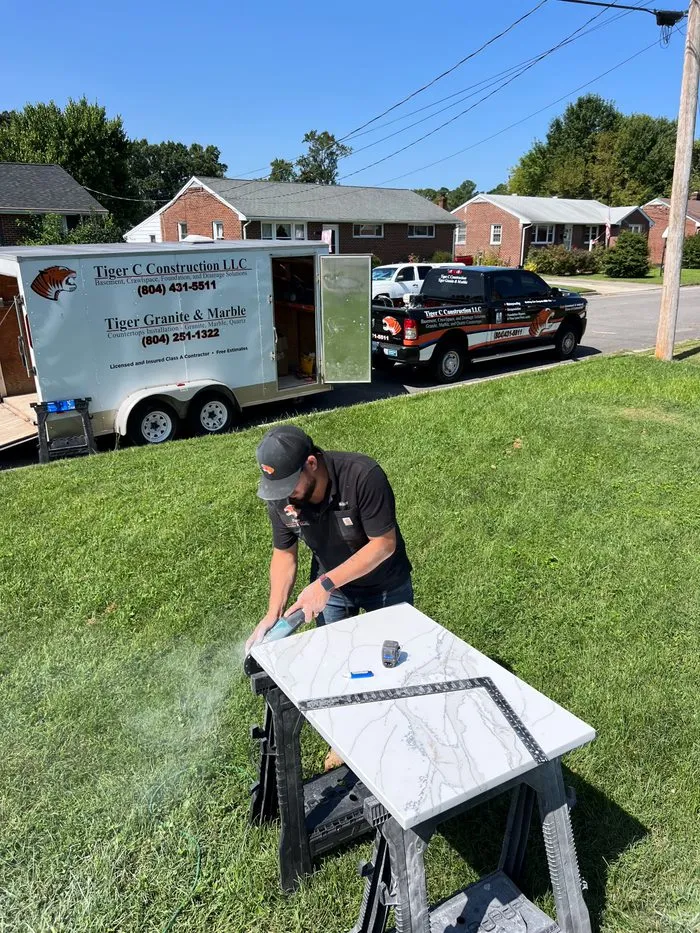
A straight edge can provide a clean, simple appearance, while a more substantial profile can make the countertop appear thicker.
For a laundry folding station, an eased edge can also be practical because clothing and arms frequently come into contact with the countertop.
The appropriate edge profile depends on the material and fabrication requirements, so the final selection should be discussed with the countertop professional.
How Much Support Does A Laundry Countertop Need?
There is no universal support distance that applies to every countertop.
Support requirements can depend on:
- Material type
- Slab thickness
- Countertop dimensions
- Overhang
- Cabinet configuration
- Wall support
- Cutouts
- Seams
- Intended use
- Fabrication requirements
Because these factors vary, general online rules about maximum unsupported spans should not replace a project-specific assessment.
A professional laundry countertop installer in Richmond, VA, can evaluate the complete layout and determine whether brackets, supports, or other structural elements are needed.
Myth: The Thickest Countertop Is Always The Best Choice
A common misconception is that selecting the thickest available countertop automatically creates the strongest laundry folding station.
It does not.
Performance depends on the relationship between material, thickness, span, support, fabrication, and installation.
Increasing thickness may affect appearance and structural characteristics, but it cannot compensate for inadequate cabinets or poorly designed support.
The better approach is to design the complete countertop system first and then select an appropriate material thickness.
What Should You Consider When Designing A Laundry Folding Station?
A well-designed folding station should balance function, durability, maintenance, and comfort.
- Folding Space: Provide enough room for sorting and folding clothes.
- Storage: Add cabinets, drawers, or shelves based on available space.
- Appliance Placement: Plan around the washer and dryer without relying on the countertop for appliance support.
- Cleaning: Choose a surface that suits the room’s exposure to water, detergent, and lint.
- Accessibility: Select a comfortable height for regular use.
Can A Laundry Countertop Be Designed Around Existing Cabinets?
Yes, provided the existing cabinets and support structure are suitable for the new countertop.
Existing cabinets should be inspected before fabrication. Accurate measurements are also necessary to account for walls, appliances, utility connections, and other features.
Tiger Granite and Marble states that its countertop installation process includes careful measurements to ensure countertops are cut to the appropriate size and shape.
This is particularly important when replacing an existing laundry surface because walls and cabinets may not be perfectly square or aligned.
What Makes A Laundry Countertop Durable?
Durability comes from more than slab thickness.
A well-designed laundry countertop combines an appropriate material with adequate support, professional fabrication, proper installation, and reasonable maintenance.
Granite can provide resistance to everyday wear, quartz offers a consistent engineered surface, and marble provides distinctive natural-stone characteristics. Each material has different maintenance considerations.
Homeowners searching for laundry countertops in Richmond can therefore evaluate countertop selection based on the complete project rather than thickness alone.
Choose Thickness As Part Of The Whole Design
The right countertop thickness for a heavy-duty laundry folding station depends on the overall design, including material, span, support, overhangs, edge treatment, cutouts, and intended use.
Granite, marble, and quartz can all suit laundry applications, with different characteristics and maintenance needs. Tiger Granite and Marble offers all three materials with custom laundry countertop solutions.
Instead of choosing the thickest slab, consult a countertop professional to determine the appropriate material, thickness, support, and installation for your space.
Contact us today to discuss your laundry countertop project and determine the right solution for your space.
People Also Ask
What countertop thickness is best for a laundry folding station?
A 3 cm countertop is a common substantial option, but the appropriate thickness depends on the material, span, support structure, edge treatment, and installation requirements.
Is granite good for a laundry folding station?
Yes. Tiger Granite and Marble offers granite for laundry applications and describes the material as durable and resistant to heat and scratches.
Is quartz suitable for laundry countertops?
Yes. Tiger Granite and Marble offers quartz for laundry projects. Its engineered construction provides a consistent range of colors and patterns.
Does a thicker countertop always prevent sagging?
No. Support, span, material, and installation also affect performance. Proper structural support is more important than simply selecting the thickest slab.